Corrido de Medianoche
One corrido, preceded by the documented story, people and moment behind it.
Online cultural radio · In development
A proposed 24-hour station where the corrido is heard not only as music, but as living history: revolution, migration, border life, family memory and the voices shaping the genre today.
The station would combine carefully licensed music with historical introductions, interviews, oral histories and original productions. The first step is a three-month pilot designed to prove the audience, schedule and operating model.
01 · Programming
The sound would travel from revolutionary and historical corridos to border and migrant stories, the U.S. scenes of the 1970s, norteño and regional wind-band traditions, and the contemporary generation—including corridos tumbados.
One corrido, preceded by the documented story, people and moment behind it.
A dedicated block centering women as performers, composers, protagonists and chroniclers.
Original recordings created with musicians and storytellers, including the collaboration planned with Charly and Charly Jr.
Interviews, family memories and archival context connecting songs to the communities that made them.
02 · A century in motion
Revolutionary, historical and community corridos that recorded events before many people encountered them in books.
Songs shaped by movement, work, distance and Mexican life in the United States—including the sounds remembered from the 1970s.
Norteño, banda sinaloense, banda zacatecana, traditional wind ensembles and the new languages of contemporary corridos.
Listen to the recording shared by Ranfery and explore the working lyrics and musical-arrangement guide in the PDF.
Musicians and bands: we invite you to perform this corrido your own way, in your own style. Make it your own with your voice, instruments and arrangements, and share your interpretation with us.
Read the corrido PDF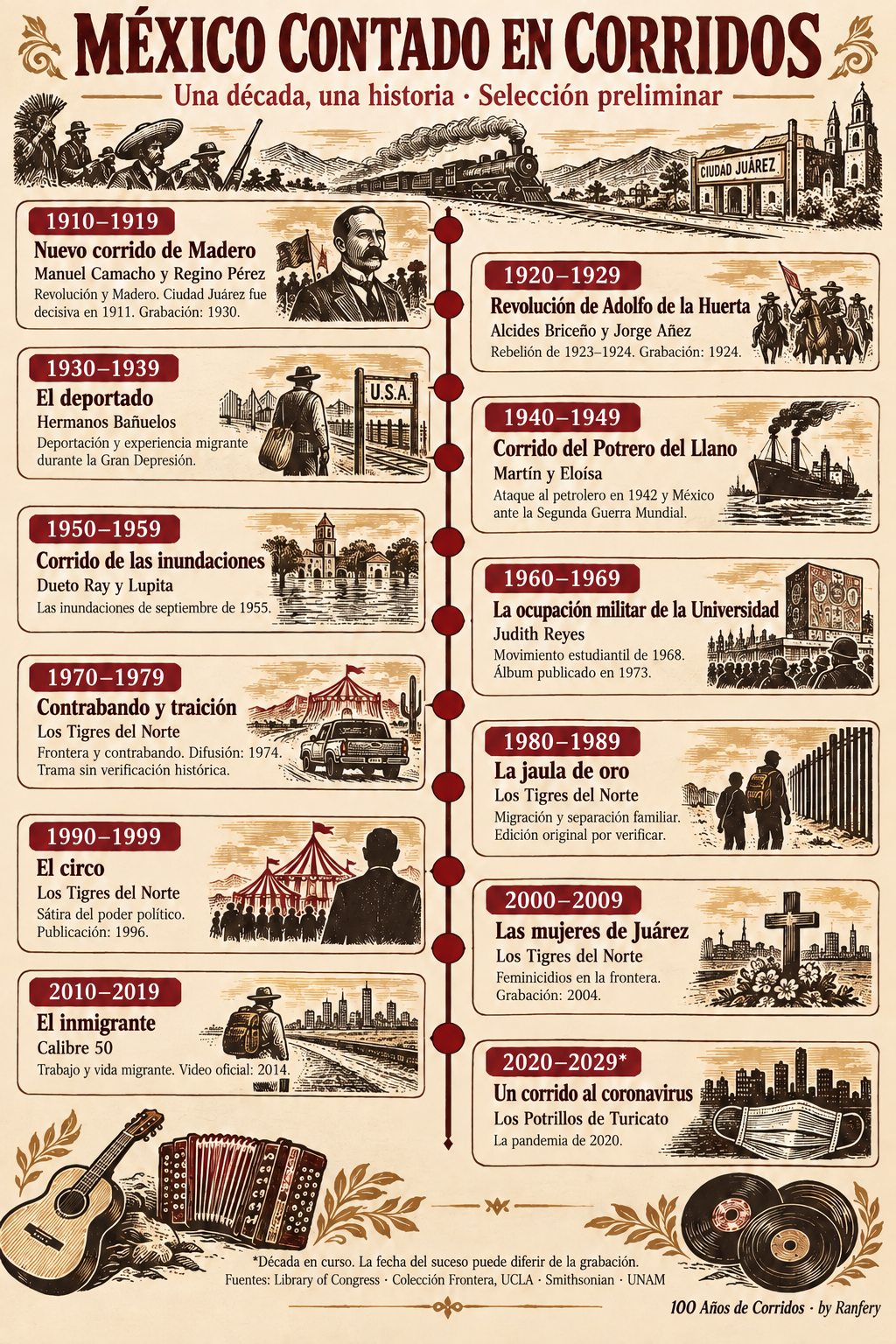
ANTHOLOGY · 1910–1919
Manuel Camacho y Regino Pérez
1910 marked the beginning of the Mexican Revolution, following Francisco I. Madero’s call to rise against Porfirio Díaz. Ciudad Juárez became decisive in May 1911: its capture by revolutionary forces helped bring about the Treaties of Ciudad Juárez on May 21, which provided for the resignations of Díaz and Vice President Ramón Corral. This border city helped change the course of Mexico’s history.
Historical period: 1910–1911. Recording documented in 1930: a musical memory of Madero and his struggles.
Listen on YouTube ↗ANTHOLOGY · 1920–1929
Alcides Briceño y Jorge Añez
Recorded on July 22, 1924—102 years ago in 2026—this is one of the oldest recordings in our emerging anthology. Its survival lets us hear how a political conflict was told through song more than a century ago.
The corrido recounts the rebellion led by Adolfo de la Huerta in 1923–1924 against Álvaro Obregón’s government, amid the presidential succession and Obregón’s support for Plutarco Elías Calles. It captures the political struggles that continued after the Revolution.
Listen on YouTube ↗Open invitation
We invite the Los Tigres del Norte Foundation—and artists, cultural foundations, universities, archives, radio professionals, equipment partners and community sponsors—to help launch a three-month pilot for 100 Años de Corridos.
Guidance, permissions and access to recordings, collections and reliable historical sources.
Licensing, hosting, production, research and the basic equipment required for the first three months.
Artists, historians, families and communities willing to share stories and help document the culture responsibly.
To Los Tigres del Norte and everyone who believes these stories deserve a future:
The corrido has carried news, memory, warning, pride and identity across generations and borders. We want to create a home where listeners can hear the music and also understand the human history inside it.
We are seeking partners who can help us begin carefully and legally, measure the audience during a three-month pilot, and build a sustainable cultural service supported primarily by listeners and brief acknowledgments—not intrusive commercial breaks. Your experience, archive, name, guidance or financial support could help turn this signal on.
— by Ranfery